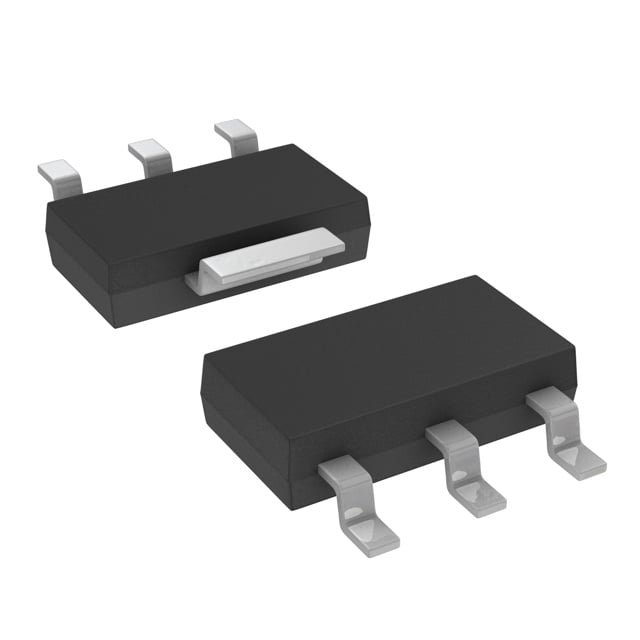
Q1: What is the STMicroelectronics LD1117S12CTR?
A1: The STMicroelectronics LD1117S12CTR is a low dropout (LDO) linear voltage regulator that provides a stable 12V output with a wide input voltage range. It is commonly used to power sensitive electronic components.
Q2: What is the input voltage range of the LD1117S12CTR?
A2: The LD1117S12CTR can operate with an input voltage range from 6.5V to 15V, providing a stable 12V output.
Q3: What is the output voltage of the LD1117S12CTR?
A3: The LD1117S12CTR provides a regulated 12V output, ideal for powering devices that require a 12V DC supply.
Q4: What is the maximum output current of the LD1117S12CTR?
A4: The LD1117S12CTR can provide a maximum output current of up to 800mA, making it suitable for powering small to medium load applications.
Q5: Does the LD1117S12CTR have thermal overload protection?
A5: Yes, the LD1117S12CTR features thermal overload protection to prevent damage due to overheating, ensuring safe and reliable operation.
Q6: What is the dropout voltage of the LD1117S12CTR?
A6: The LD1117S12CTR has a typical dropout voltage of 1.1V at 800mA of load current, which is characteristic of LDO regulators.
Q7: What type of package does the LD1117S12CTR come in?
A7: The LD1117S12CTR is available in a TO-220 package, which is commonly used for power devices due to its ability to dissipate heat effectively.
Q8: What is the typical quiescent current of the LD1117S12CTR?
A8: The typical quiescent current of the LD1117S12CTR is about 5mA, making it efficient for low-power applications.
Q9: Is the LD1117S12CTR suitable for automotive applications?
A9: Yes, the LD1117S12CTR can be used in automotive applications, as it is designed to operate within a wide input voltage range and is capable of handling the voltage fluctuations typically seen in automotive environments.
Q10: Can the LD1117S12CTR be used in battery-powered devices?
A10: Yes, the LD1117S12CTR is suitable for battery-powered devices as it has a low quiescent current and is efficient at converting input voltage to a stable 12V output.
Q11: What is the output tolerance of the LD1117S12CTR?
A11: The output voltage tolerance of the LD1117S12CTR is typically ±2%, ensuring reliable regulation within this margin.
Q12: Does the LD1117S12CTR require external capacitors for stable operation?
A12: Yes, the LD1117S12CTR typically requires a capacitor on both the input and output for stable operation. A 10µF tantalum or ceramic capacitor is recommended for best performance.
Q13: What is the maximum power dissipation of the LD1117S12CTR?
A13: The maximum power dissipation of the LD1117S12CTR depends on the input-output voltage difference and the output current. At 800mA, the power dissipation can be estimated as the product of the dropout voltage and the current.
Q14: What are the common applications of the LD1117S12CTR?
A14: The LD1117S12CTR is commonly used in applications such as powering sensors, microcontrollers, analog-to-digital converters, and other low-to-medium power devices that require a stable 12V supply.
Q15: Is the LD1117S12CTR short-circuit protected?
A15: Yes, the LD1117S12CTR is equipped with short-circuit protection, ensuring the regulator is protected in the event of a short circuit at the output.
Q16: Can the LD1117S12CTR be used in industrial environments?
A16: Yes, the LD1117S12CTR is designed to operate in a wide temperature range, typically from -40°C to 125°C, making it suitable for industrial applications.
Q17: Does the LD1117S12CTR have overcurrent protection?
A17: Yes, the LD1117S12CTR features overcurrent protection, which helps prevent damage to the device or the powered circuit when the output current exceeds safe limits.
Q18: What is the typical ripple rejection of the LD1117S12CTR?
A18: The LD1117S12CTR has a typical ripple rejection of around 60dB at 120Hz, helping to suppress noise and fluctuations in the output voltage.
Q19: Is the LD1117S12CTR suitable for use in consumer electronics?
A19: Yes, the LD1117S12CTR is commonly used in consumer electronics such as audio equipment, power supplies, and communication devices due to its stability, reliability, and efficiency.
Q20: Can the LD1117S12CTR be used in high-efficiency designs?
A20: While the LD1117S12CTR is efficient for many applications, it is not as efficient as switching regulators for high-power applications due to its inherent dropout voltage. It is best suited for low to medium power applications.