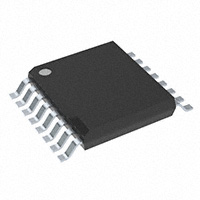
The PCA9554ADBR is a sophisticated I²C-bus I/O port expander offered by Texas Instruments. It is designed to provide additional input/output (I/O) pins for microcontrollers or microprocessors, especially useful in applications where the number of available GPIO pins is insufficient. The PCA9554A is particularly suited for interfacing with various peripherals, enabling a more flexible design in embedded systems.
## Key Features
1. I²C Interface: The PCA9554ADBR communicates over the I²C bus, allowing it to connect multiple devices using only two wires, which simplifies connections and reduces pin count.
2. 16 Bits of I/O: This device provides 16 configurable I/O pins, which can be individually set as either inputs or outputs. This flexibility allows for a wide range of applications.
3. Interrupt Functionality: The PCA9554ADBR includes an interrupt output pin that signals when any of the input states change, allowing the microcontroller to respond to events without constantly polling the device.
4. Wide Voltage Range: The device operates from a supply voltage of 2.3 V to 5.5 V, making it compatible with a variety of logic levels and suitable for many different systems.
5. Open-Drain Outputs: The I/O pins can sink current but are capable of handling external pull-up resistors, which is ideal for connecting to various types of devices and buses.
6. Low Power Consumption: The PCA9554ADBR features low standby current, making it suitable for battery-powered applications where energy efficiency is critical.
7. Multiple Device Support: Up to eight PCA9554A devices can be connected on the same I²C bus, expanding the number of available I/O pins even further.
8. Power-On Reset: The device has an integrated power-on reset feature that ensures the device starts in a known state upon power-up.
## Electrical Specifications
Here’s a summary of the key electrical specifications for the PCA9554ADBR:
| Parameter | Value |
|------------------------------------|-----------------------------------------|
| Supply Voltage (VCC) | 2.3 V to 5.5 V |
| Input Voltage (VIN) | VSS to VCC |
| I/O Port Voltage (VI/O) | VSS to VCC |
| I/O Current (per pin) | ±25 mA |
| Operating Temperature Range | -40°C to +85°C |
| Bus Frequency (I²C) | Up to 1 MHz |
| Interrupt Output Type | Open-drain |
| Maximum I/O Pins | 16 |
| Power Consumption | 10 µA typical (active) |
| Power-On Reset Time | 100 µs typical |
## Pin Configuration
The PCA9554ADBR is available in a 20-pin TSSOP package, providing a compact footprint ideal for space-constrained applications. Below is a simplified pin configuration:
```
+-------------------+
| 1 VSS |
| 2 P0.0 |
| 3 P0.1 |
| 4 P0.2 |
| 5 P0.3 |
| 6 P0.4 |
| 7 P0.5 |
| 8 P0.6 |
| 9 P0.7 |
| 10 P1.0 |
| 11 P1.1 |
| 12 P1.2 |
| 13 P1.3 |
| 14 P1.4 |
| 15 P1.5 |
| 16 P1.6 |
| 17 P1.7 |
| 18 SDA |
| 19 SCL |
| 20 VCC |
+-------------------+
```
## Applications
The PCA9554ADBR is versatile and can be used in a variety of applications, including:
1. Embedded Systems: Expanding GPIO capability in microcontroller-based designs.
2. Consumer Electronics: Interfacing buttons, LEDs, and other peripherals in devices like remote controls and appliances.
3. Industrial Automation: Connecting sensors, actuators, and control devices in factory environments.
4. Automotive Applications: Providing additional I/O for automotive control systems where space is limited.
5. Communication Equipment: Supporting additional control signals in network devices and routers.
## Design Considerations
When designing with the PCA9554ADBR, consider the following:
- Pull-Up Resistors: External pull-up resistors may be required on the I/O lines to ensure the correct logic levels are maintained, especially when used as inputs.
- Voltage Compatibility: Ensure the supply voltage matches the requirements of the system in which it is being used, especially when interfacing with other logic levels.
- Interrupt Handling: Implement efficient interrupt service routines in the microcontroller firmware to handle changes on the input pins effectively.
## Conclusion
The PCA9554ADBR from Texas Instruments is an excellent choice for applications requiring additional I/O ports in a compact, efficient package. Its I²C interface, low power consumption, and flexible configuration make it suitable for a wide range of embedded system designs. For detailed design guidelines and application notes, refer to the official Texas Instruments documentation and datasheet.