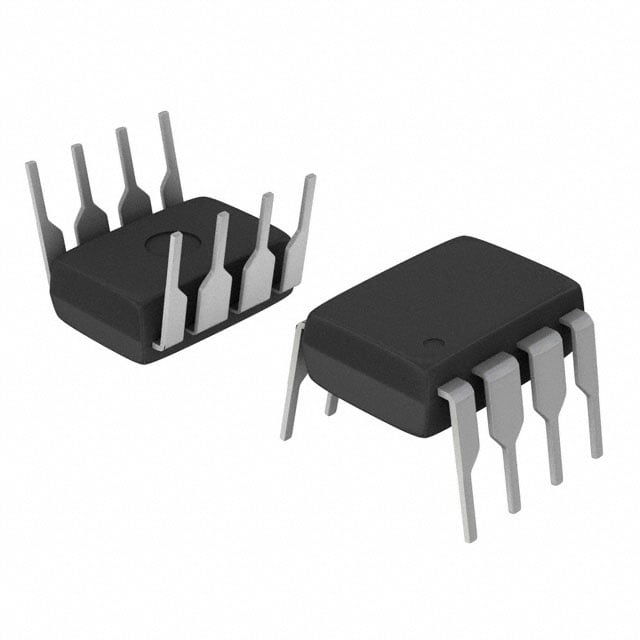
Texas Instruments REF2025AIDDCR Detailed Overview
The Texas Instruments REF2025AIDDCR is a high-precision, low-drift, dual-channel voltage reference device specifically designed for applications requiring high accuracy, low power consumption, and thermal stability. It integrates two independent voltage references—one providing a fixed 2.5 V output and the other a matched current source suitable for biasing precision sensors such as RTDs and thermistors. This combination of a voltage reference and a current source in a single device makes the REF2025AIDDCR ideal for compact, precision analog front-end systems.
Voltage Reference Characteristics
At the heart of the REF2025AIDDCR is a 2.5 V precision bandgap reference with ultra-low drift and tight initial accuracy. The device delivers excellent performance over temperature and time, critical for instrumentation and metrology systems.
* Output Voltage: 2.5 V (±0.05% initial accuracy)
* Initial Accuracy: ±0.05% (typical ±1.25 mV)
* Temperature Coefficient (Max): 8 ppm/°C
* Output Noise (0.1 Hz to 10 Hz): 3.4 µVPP (typical)
* Long-Term Stability (1000 hrs): 25 ppm (typical)
The voltage reference output is buffered with a low-noise amplifier capable of sourcing and sinking current while maintaining voltage stability.
Current Source Characteristics
The REF2025AIDDCR includes a matched current source channel designed to provide a 100 µA ±0.5% output, optimized for precision sensor excitation.
* Output Current: 100 µA (±0.5% initial accuracy)
* Temperature Coefficient: 10 ppm/°C (typical)
* Compliance Voltage Range: 1.7 V to 5.5 V
* Load Regulation: <10 ppm/mA
* Output Noise (0.1 Hz to 10 Hz): 150 nARMS
This current source ensures minimal drift and high matching for differential sensor topologies.
Power Supply and Power Dissipation
The REF2025AIDDCR operates from a wide supply range, with excellent power efficiency, making it ideal for portable or battery-powered precision systems.
* Supply Voltage Range: 2.7 V to 5.5 V
* Supply Current: 75 µA (typical)
* Power Dissipation: <500 µW (typical at 3 V supply)
The low quiescent current helps minimize thermal gradients and reduces self-heating effects in temperature-sensitive circuits.
Output Drive and Load Capacitance Stability
The voltage reference output is capable of sourcing up to ±5 mA while maintaining output voltage stability. It also supports capacitive loads up to 10 µF without oscillation, facilitating direct interface with ADC inputs or sensor bridges.
* Output Drive Capability: ±5 mA (typical)
* Capacitive Load Stability: Up to 10 µF
Package and Thermal Performance
The REF2025AIDDCR is housed in a compact SOT-23-6 (DDC) package, optimized for space-constrained designs. Despite its small size, the package supports efficient thermal dissipation, which contributes to long-term accuracy.
* Package Type: SOT-23-6 (DDC)
* Package Size: 2.9 mm × 1.6 mm × 1.12 mm (nominal)
* Thermal Resistance (θJA): 150 °C/W (typical)
Application Areas
The REF2025AIDDCR is highly suited for a wide variety of high-precision applications, especially those where both a voltage reference and a precision current source are needed:
* RTD and thermistor temperature measurement systems
* Bridge sensor excitation (e.g., strain gauges)
* High-resolution analog-to-digital conversion
* Portable data acquisition systems
* Industrial instrumentation
* Medical instrumentation (e.g., ECG/EEG front ends)
* Battery-powered metrology devices
Key Features Summary
* Dual-output: 2.5 V precision voltage reference and 100 µA current source
* High initial accuracy: ±0.05% (voltage), ±0.5% (current)
* Low drift: 8 ppm/°C max for voltage, 10 ppm/°C typ for current
* Ultra-low power: 75 µA supply current
* Excellent long-term stability and noise performance
* SOT-23-6 package for compact designs
The REF2025AIDDCR represents a cost-effective and space-saving solution for applications where tight voltage reference accuracy and consistent current drive are both critical. Its integration, precision, and thermal performance make it an indispensable component for modern analog system design.