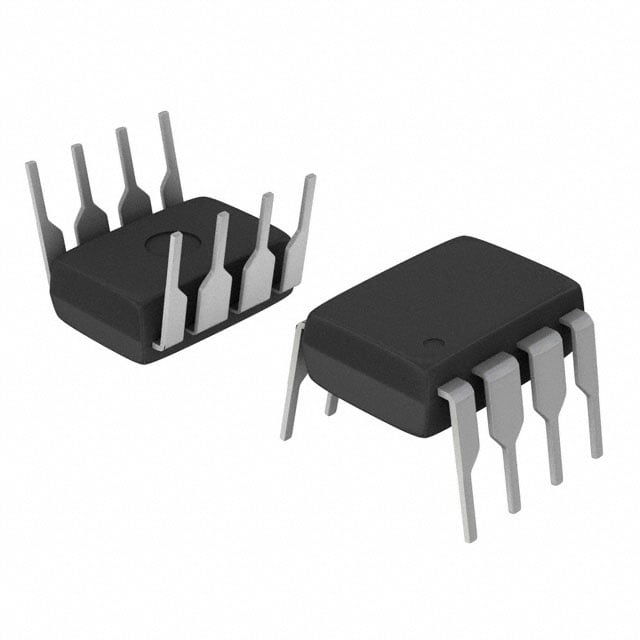
Q1: What is the Broadcom HCPL-6751?
A1: The Broadcom HCPL-6751 is an optocoupler designed for high-speed data transmission applications, offering a high degree of isolation between input and output.
Q2: What is the primary function of the HCPL-6751?
A2: The HCPL-6751 functions as an optocoupler, providing electrical isolation and noise immunity while transmitting data at high speeds.
Q3: What type of input and output does the HCPL-6751 support?
A3: The HCPL-6751 has a photodiode and a phototransistor output, designed to handle digital signals efficiently while maintaining isolation.
Q4: What is the data transmission speed supported by the HCPL-6751?
A4: The HCPL-6751 supports data transmission speeds up to 10 Mbps, making it suitable for high-speed communication applications.
Q5: What is the operating voltage range of the HCPL-6751?
A5: The HCPL-6751 operates with a voltage range from 4.5V to 5.5V, allowing flexibility for different systems and applications.
Q6: What is the isolation voltage of the HCPL-6751?
A6: The HCPL-6751 provides an isolation voltage of 2500Vrms, offering robust protection for sensitive circuits from electrical surges.
Q7: In what types of applications is the HCPL-6751 commonly used?
A7: The HCPL-6751 is commonly used in industrial automation, communication systems, and power supplies where electrical isolation and high-speed signal transmission are required.
Q8: Does the HCPL-6751 have any built-in protection features?
A8: Yes, the HCPL-6751 is designed to provide protection against voltage spikes and transients, which helps ensure reliability and long-term operation in demanding environments.
Q9: What is the maximum operating temperature range of the HCPL-6751?
A9: The HCPL-6751 has an operating temperature range of -40°C to +100°C, making it suitable for industrial and other harsh environments.
Q10: How does the HCPL-6751 achieve electrical isolation?
A10: The HCPL-6751 uses optical isolation, where a light-emitting diode (LED) and photodetector work together to transfer the signal without direct electrical contact, ensuring safety and reducing noise.
Q11: What is the typical response time of the HCPL-6751?
A11: The HCPL-6751 has a typical propagation delay of 30 ns, which allows it to transmit data quickly and efficiently in high-speed systems.
Q12: Can the HCPL-6751 be used for analog signals?
A12: The HCPL-6751 is designed primarily for digital signal transmission and is not typically used for analog signals.
Q13: What is the typical input current for the HCPL-6751?
A13: The typical input current for the HCPL-6751 is approximately 10 mA, depending on the operating conditions and signal levels.
Q14: Does the HCPL-6751 require any special drivers or components?
A14: The HCPL-6751 can operate with standard drivers or components compatible with its input voltage range and current requirements.
Q15: How is the HCPL-6751 mounted?
A15: The HCPL-6751 is available in an 8-pin PDIP (Plastic Dual In-line Package) or an SOIC (Small Outline Integrated Circuit) package for easy mounting on standard circuit boards.
Q16: Is the HCPL-6751 suitable for use in consumer electronics?
A16: The HCPL-6751 is typically used in industrial and commercial applications rather than consumer electronics due to its high-speed and isolation features, which are more suited for demanding environments.
Q17: What are the key advantages of using the HCPL-6751?
A17: The key advantages of using the HCPL-6751 include its high-speed performance, robust isolation, low power consumption, and suitability for noise-sensitive applications.
Q18: Does the HCPL-6751 require any external components for operation?
A18: The HCPL-6751 typically requires only a few external components, such as resistors, to set the input current and ensure proper operation.
Q19: What is the maximum input voltage for the HCPL-6751?
A19: The maximum input voltage for the HCPL-6751 is 5.5V, which is compatible with typical logic levels used in most digital systems.
Q20: Is the HCPL-6751 RoHS compliant?
A20: Yes, the HCPL-6751 is RoHS compliant, meaning it is free from hazardous materials such as lead and is suitable for environmentally conscious applications.