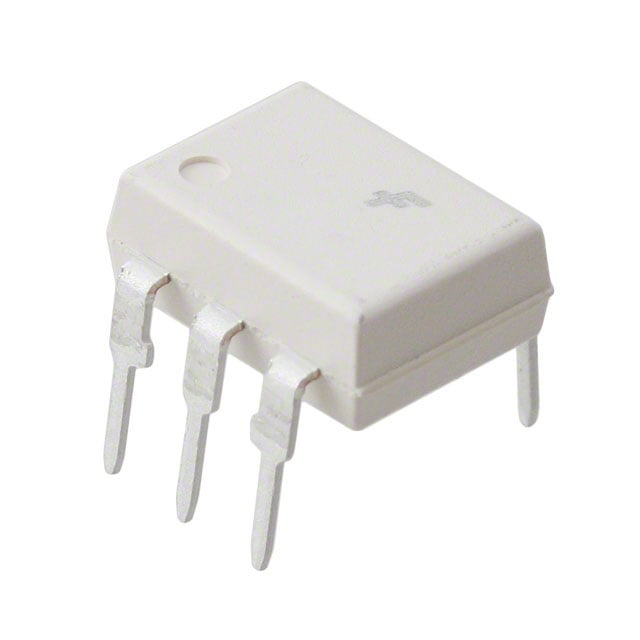
onsemi H11B1M Detailed Overview
The onsemi H11B1M is an optically isolated optocoupler that integrates a gallium arsenide infrared emitting diode (IR LED) and a phototransistor within a single 6-pin dual-in-line package (DIP). Designed primarily for signal isolation, switching, and noise reduction in digital and analog circuits, this device enables safe signal transmission between circuits with different voltage potentials. The H11B1M is widely used in applications such as power supply feedback loops, signal isolation in industrial control systems, and microcontroller input protection.
Core Functionality
The H11B1M provides electrical isolation between the input and output stages using optical transmission. When a current flows through the internal IR LED, it emits light that activates the phototransistor, allowing signal conduction across the isolation barrier. This mechanism ensures galvanic isolation, which protects low-voltage circuitry from high-voltage transients or noise.
* Type: Phototransistor optocoupler
* Isolation Method: Infrared LED and silicon phototransistor
* Insulation Voltage: Provides high electrical isolation between input and output stages
* Coupling: Non-inverting, with signal on input side triggering output conduction
Electrical Characteristics
* Input Forward Voltage (VF):
– Typical: 1.2 V
– Maximum: 1.5 V at IF = 10 mA
* Input Forward Current (IF):
– Maximum rated: 60 mA
* Collector-Emitter Breakdown Voltage (VCEO):
– Minimum: 70 V
* Emitter-Collector Breakdown Voltage (VECO):
– Minimum: 7 V
* Collector Current (IC):
– Maximum: 50 mA
* Saturation Voltage (VCE(sat)):
– Typical: 0.2 V at IC = 2 mA and IF = 10 mA
Current Transfer Ratio (CTR)
* CTR (Current Transfer Ratio):
– Typical: 20% to 300%, depending on operating conditions
– Defined as IC/IF × 100%
– Tested at VCE = 5 V, IF = 10 mA
* CTR Classification: The H11B1M is selected for higher CTR ranges compared to standard H11B1 parts
* CTR Degradation: Very low, making it suitable for long operational lifetimes in industrial settings
Isolation and Safety Ratings
* Isolation Voltage (VISO):
– Rated at 5300 Vrms (1 minute test)
– Provides robust isolation between input and output circuits
* Creepage Distance: Meets IEC safety standards for insulation
* Insulation Resistance: ≥10⁹ Ω at 500 VDC
* Common Mode Transient Immunity (CMTI): Designed to resist high dv/dt events (though exact CMTI ratings are not specified in this model, the DIP6 package provides high immunity)
Switching Characteristics
* Rise Time (tr): Typical 4 µs
* Fall Time (tf): Typical 3 µs
* Turn-on Delay (ton): ~4 µs
* Turn-off Delay (toff): ~4 µs
* Switching Speed: Suitable for low- to medium-speed digital signal isolation
Thermal and Environmental Characteristics
* Operating Temperature Range: –55°C to +100°C
* Storage Temperature Range: –55°C to +150°C
* Power Dissipation (PD):
– Input side: Up to 100 mW
– Output side: Up to 150 mW
* Thermal Resistance (θJA): Approx. 200°C/W in free air
* Package Material: Flame retardant epoxy resin, UL94V-0 rated
Mechanical Characteristics
* Package Type: 6-pin DIP (Dual In-line Package)
* Mounting Style: Through-hole (DIP-6)
* Lead Finish: Tin-plated leads for solderability
* Body Dimensions:
– Length: ~10 mm
– Width: ~7 mm
– Height: ~3.5 mm
Typical Applications
* Switch Mode Power Supplies (SMPS): For feedback loop signal isolation
* Industrial Automation: Isolating control logic from field I/O
* Microcontroller Interface Protection: Isolating I/O ports from high-voltage signals
* Data Acquisition Systems: Noise-free digital signal transmission
* Signal Isolation in Measurement Equipment
* Appliances and HVAC Systems: Control signal interfacing
Design Guidelines and Considerations
* Use a current-limiting resistor in series with the input to control IF
* Ensure proper pull-up or pull-down resistors on the phototransistor output depending on the logic system
* Maintain adequate PCB clearance and creepage for high-voltage isolation applications
* Avoid placing high-frequency switching traces near the optocoupler output pins to minimize susceptibility to EMI
* Consider CTR variations over temperature and aging when designing with tight timing or current margins
Conclusion
The onsemi H11B1M is a reliable and cost-effective optocoupler offering high isolation, solid performance, and wide applicability in both analog and digital domains. Its high CTR, low saturation voltage, and DIP-6 format make it particularly suitable for robust signal isolation in industrial, consumer, and automotive systems. With its low power consumption and standard pinout, the H11B1M simplifies the design of isolated interfaces while ensuring system safety and longevity.