Product Overview
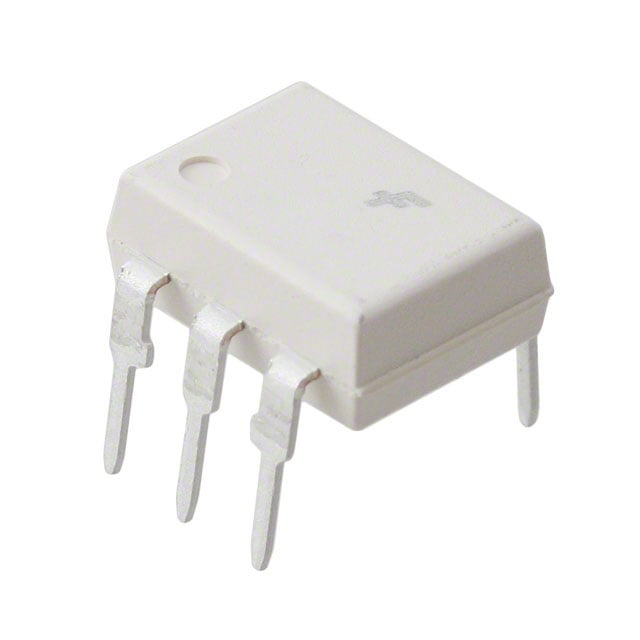
The Isocom Components MOC8050 is an optocoupler designed to provide galvanic isolation between input and output circuits, facilitating safe signal transmission in electronic systems. This device is widely used in power control, signal isolation, and interfacing applications where high-voltage isolation and noise immunity are required. The MOC8050 uses an infrared LED to drive a phototransistor output, ensuring electrical isolation and enabling low-level signal transfer across different voltage domains. Its design focuses on reliability, fast response, and low power consumption, making it suitable for industrial, telecommunications, and consumer electronics.
Construction and Operation Principle
The MOC8050 consists of two main components integrated into a single package: an infrared emitting diode (LED) on the input side and a phototransistor on the output side. When the LED is energized by an input current, it emits infrared light, which is detected by the phototransistor, causing it to conduct and thus transfer the signal electrically isolated from the input. This optical coupling allows the MOC8050 to isolate the input circuit from the output, protecting sensitive electronics from high voltages, spikes, and noise.
Key Features
* High Isolation Voltage: Provides strong galvanic isolation, typically rated for up to 5,000 Vrms, ensuring safety and preventing electrical interference between circuits.
* Phototransistor Output: Offers a linear and amplified output suitable for interfacing with digital and analog circuits.
* Low Input Current Requirement: The LED requires a low forward current to operate, reducing power consumption.
* Wide Operating Temperature Range: Suitable for operation in industrial environments with temperatures from -55°C to +100°C.
* Fast Switching Speed: Enables relatively quick response times for signal transmission in control and communication applications.
* Compact 6-pin DIP Package: The MOC8050 comes in a standard dual in-line package, facilitating easy PCB mounting and replacement.
Electrical Specifications
* Input LED Forward Voltage (V\_F): Typically around 1.2 V at a forward current of 20 mA.
* Input LED Forward Current (I\_F): Maximum continuous forward current is 60 mA; typical operating current is 10-20 mA.
* Input Reverse Voltage (V\_R): Maximum of 6 V to avoid LED damage.
* Output Collector-Emitter Voltage (V\_CE): Maximum voltage the phototransistor can handle between collector and emitter is 30 V.
* Output Collector Current (I\_C): Maximum continuous collector current is 50 mA.
* Isolation Voltage: Typically 5,000 Vrms for 1 minute between input and output terminals, ensuring robust isolation.
* Current Transfer Ratio (CTR): Ranges from 20% to 300% depending on test conditions and device variants, indicating the efficiency of input LED current to output transistor current transfer.
* Response Time: Typical rise and fall times are in the microsecond range (e.g., 3 µs to 10 µs), suitable for medium-speed switching applications.
* Power Dissipation: Maximum package power dissipation is approximately 300 mW, ensuring safe operation within thermal limits.
Mechanical and Physical Characteristics
* Package Type: 6-pin Dual Inline Package (DIP), compatible with through-hole PCB assembly.
* Pin Configuration: Pins include LED anode and cathode on the input side, collector and emitter on the phototransistor output side, and two no-connect or substrate pins depending on specific device version.
* Dimensions: Standard 6-pin DIP dimensions with a typical width of about 7.62 mm (0.3 inches) and length approximately 9.8 mm, allowing compatibility with common socket and PCB footprints.
* Weight: Lightweight, typically less than 1 gram, facilitating use in compact assemblies.
Performance Characteristics
* Isolation and Safety: The MOC8050’s high isolation voltage rating makes it ideal for safety-critical applications where separation between low-voltage control circuits and high-voltage power circuits is mandatory.
* Low Noise Immunity: By optical coupling, the device prevents ground loops and electromagnetic interference from crossing between the input and output.
* Signal Integrity: The phototransistor output provides a strong and stable signal suitable for microcontroller inputs, logic circuitry, and analog interfacing.
* Reliability: The solid-state nature and optical isolation contribute to long operational life and minimal maintenance.
* Wide Application Range: Supports a variety of signals, including DC and low-frequency AC, suitable for switch control, signal monitoring, and communication line isolation.
Applications
* Industrial Automation: Isolates sensor signals, control signals, and communication lines from high-voltage machinery, enhancing safety and noise immunity.
* Power Supply Feedback: Provides feedback isolation in switching power supplies and converters.
* Telecommunications Equipment: Used for line isolation and signal coupling in telecom interface circuits.
* Microprocessor Interfacing: Enables safe connection between microcontroller logic levels and high-voltage or noisy environments.
* Medical Equipment: Ensures patient safety by isolating monitoring and diagnostic circuits.
* Consumer Electronics: Protects delicate circuitry in appliances and electronic devices from high voltage spikes.
Environmental and Reliability Characteristics
* Operating Temperature: Functional from -55°C to +100°C, suitable for harsh environments.
* Storage Temperature: Typically ranges from -55°C to +125°C.
* Humidity Resistance: Designed to operate reliably under varying humidity conditions, though care is recommended in high moisture environments.
* Compliance: Meets industry standards for safety and environmental compliance, including RoHS directives.
Summary
The Isocom Components MOC8050 optocoupler is a robust, versatile device ideal for applications requiring electrical isolation and signal transfer between high and low voltage systems. Its combination of high isolation voltage, low input current, phototransistor output, and reliable operation over a wide temperature range makes it suitable for industrial, telecommunications, medical, and consumer electronics applications. The device’s standard 6-pin DIP package facilitates easy integration into a broad range of electronic systems, delivering dependable isolation and signal integrity in demanding environments.