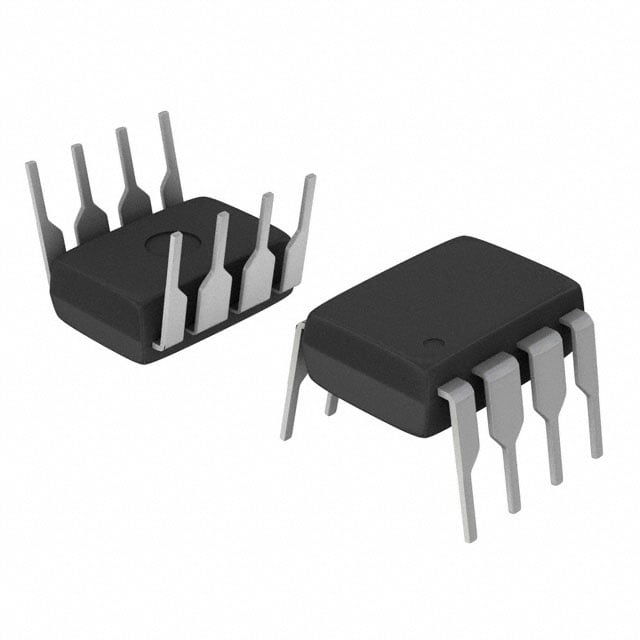
Q1: What is the Vishay ILD256T?
A1: The Vishay ILD256T is a high-performance optocoupler designed for electrical isolation in applications where precise and reliable signal transmission is required.
Q2: What type of optocoupler is the Vishay ILD256T?
A2: The Vishay ILD256T is a phototransistor optocoupler, which uses a phototransistor as the output element to convert the light signal from the LED input into an electrical signal.
Q3: What is the isolation voltage of the Vishay ILD256T?
A3: The Vishay ILD256T offers an isolation voltage of 5,000 VRMS, ensuring reliable protection between high-voltage and low-voltage circuits.
Q4: What is the package type of the Vishay ILD256T?
A4: The Vishay ILD256T comes in a compact 4-pin DIP (Dual In-line Package), making it suitable for standard through-hole mounting applications.
Q5: What is the input current for the Vishay ILD256T?
A5: The typical input current for the Vishay ILD256T is 5mA, which is required to activate the LED inside the optocoupler and initiate the signal transfer.
Q6: What is the typical forward voltage of the LED in the Vishay ILD256T?
A6: The typical forward voltage for the LED in the Vishay ILD256T is around 1.2V when driven by a current-limited source.
Q7: What is the maximum output current for the Vishay ILD256T?
A7: The Vishay ILD256T can handle a maximum output current of 50mA, making it suitable for driving low-power logic circuits, relays, or other load devices.
Q8: What is the operating temperature range of the Vishay ILD256T?
A8: The Vishay ILD256T operates within a temperature range of -40°C to +100°C, making it suitable for use in industrial and automotive environments.
Q9: What is the response time of the Vishay ILD256T?
A9: The Vishay ILD256T has a typical response time of 1μs, making it suitable for high-speed applications requiring fast signal transmission.
Q10: Can the Vishay ILD256T be used in power supply applications?
A10: Yes, the Vishay ILD256T is suitable for power supply applications, especially for feedback isolation and switching power supplies.
Q11: What is the current transfer ratio (CTR) of the Vishay ILD256T?
A11: The typical current transfer ratio (CTR) for the Vishay ILD256T is between 50% to 600%, depending on the specific operating conditions, providing flexible output drive capabilities.
Q12: What are the primary applications for the Vishay ILD256T?
A12: The Vishay ILD256T is commonly used in applications such as signal isolation, data communication, microcontroller protection, and power supply feedback loops.
Q13: Does the Vishay ILD256T support high-speed data transmission?
A13: Yes, the Vishay ILD256T supports moderate-speed data transmission, with a fast response time suitable for signal isolation in high-speed systems.
Q14: Can the Vishay ILD256T be used in automotive applications?
A14: Yes, the Vishay ILD256T can be used in automotive applications, particularly in isolation circuits within automotive control systems, where reliability and electrical isolation are essential.
Q15: Is the Vishay ILD256T suitable for low-power applications?
A15: Yes, the Vishay ILD256T is designed for low-power consumption, making it ideal for energy-efficient systems and battery-operated devices.
Q16: How does the Vishay ILD256T provide electrical isolation?
A16: The Vishay ILD256T uses an LED on the input side and a phototransistor on the output side to transmit signals optically, ensuring electrical isolation between the two sides of the circuit.
Q17: What is the maximum collector-emitter voltage (Vce) for the Vishay ILD256T?
A17: The maximum collector-emitter voltage (Vce) for the Vishay ILD256T is 80V, which makes it suitable for many standard signal isolation tasks in low- to moderate-voltage circuits.
Q18: What are the pin functions of the Vishay ILD256T?
A18: The Vishay ILD256T has four pins: anode (pin 1) and cathode (pin 2) for the input LED, and collector (pin 3) and emitter (pin 4) for the phototransistor output.
Q19: How do I choose the right optocoupler for my application?
A19: When choosing an optocoupler like the Vishay ILD256T, consider factors such as isolation voltage, current transfer ratio (CTR), response time, package type, and operating temperature range to match your application’s requirements.
Q20: Where can I find more information on the Vishay ILD256T?
A20: Detailed datasheets, application notes, and technical specifications for the Vishay ILD256T are available on the official Vishay website and through authorized distributors.