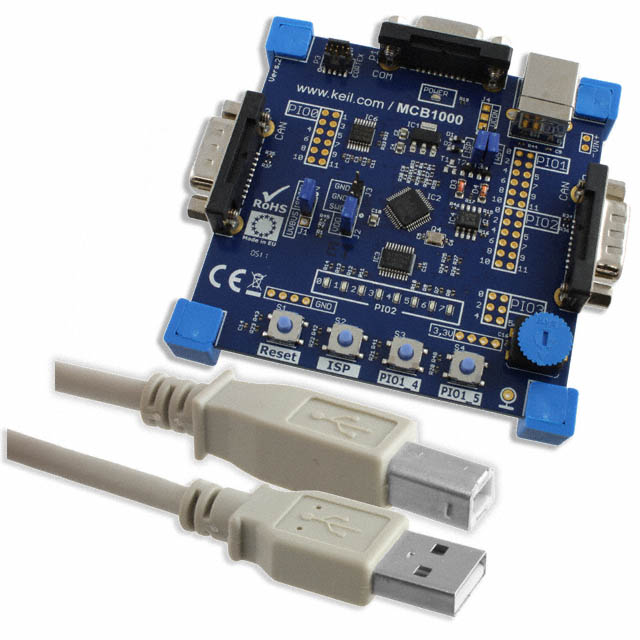
The ARM MCBSTM32F400 is a development board designed to provide a comprehensive platform for evaluating the capabilities of the STM32F4 series of microcontrollers. Based on the ARM Cortex-M4 processor, the board offers robust performance, extensive peripheral support, and various development tools, making it ideal for developing embedded systems across various applications, such as industrial automation, automotive, IoT, and consumer electronics.
## Key Specifications
* Microcontroller: STM32F407VG (ARM Cortex-M4 with FPU)
* Core Architecture: ARM Cortex-M4, 32-bit RISC processor with a floating-point unit (FPU)
* Clock Speed: Up to 168 MHz
* Flash Memory: 1 MB
* RAM: 192 KB
* GPIO Pins: 82 general-purpose input/output (GPIO) pins
* Timers: 14 timers (including basic, general-purpose, and advanced-control)
* Communication Interfaces:
* 3 x UART
* 3 x SPI
* 2 x I2C
* 1 x USB 2.0 (Full-speed)
* 2 x CAN
* 1 x SDIO
* 1 x Ethernet MAC (supports 10/100)
* 1 x I2S
* Analog-to-Digital Converter (ADC): 12-bit, up to 16 channels
* Digital-to-Analog Converter (DAC): 12-bit, 2 channels
* Power Supply: 3.3V and 5V input
* Package: 100-pin LQFP (Low-profile Quad Flat Package)
* Dimensions: 75 mm x 50 mm
* Form Factor: Development board for easy prototyping and debugging
## Physical Characteristics
* Compact Design: The MCBSTM32F400 is a compact development board (75 mm x 50 mm), making it easy to integrate into test systems, educational setups, or product prototypes. It has been optimized for use on benches, with clear pin markings and access to all GPIO, communication interfaces, and power supply pins.
* Connector Options: The development board offers multiple connectors and headers to interface with external components, including LEDs, switches, buttons, external sensors, displays, and more. This makes it ideal for quick prototyping and testing in various application fields.
* LEDs and User Buttons: The MCBSTM32F400 comes with multiple user LEDs and push-buttons, which facilitate testing and user interaction with the microcontroller, allowing developers to easily implement simple I/O functions for evaluation purposes.
## Electrical Characteristics
* Input Voltage: The development board operates with a 3.3V logic level and can accept an input voltage of 5V. It uses onboard voltage regulators to step down and provide the required power for the STM32F407VG microcontroller and peripherals.
* Flash and RAM: With 1 MB of flash memory and 192 KB of RAM, the MCBSTM32F400 offers sufficient resources for moderately complex applications. The flash memory allows for storing application code, while the RAM provides space for running data buffers, stacks, and buffers for I/O processes.
* Power Consumption: The board supports low-power operation, which is suitable for battery-operated and energy-efficient embedded systems. The microcontroller's low-power modes, such as Sleep and Stop modes, allow users to design power-efficient systems that need to conserve energy over extended periods.
## Performance Features
* ARM Cortex-M4 Processor: The STM32F407VG microcontroller is powered by the ARM Cortex-M4 core, a 32-bit RISC processor that delivers excellent performance with a 168 MHz clock speed. It provides an efficient processing environment for both real-time and non-real-time tasks.
* Floating-Point Unit (FPU): The integrated floating-point unit (FPU) supports single-precision (32-bit) floating-point arithmetic. This feature is essential for applications involving signal processing, mathematical calculations, or other floating-point operations.
* Advanced Peripherals: The STM32F407VG microcontroller comes with advanced peripherals such as high-speed timers, multiple communication interfaces, and dedicated modules for real-time control applications. The presence of an Ethernet MAC and support for SDIO and CAN protocols makes it suitable for networking and automotive applications.
## Integrated Peripherals
* Timers: The MCBSTM32F400 includes 14 timers, including basic timers, general-purpose timers, and advanced-control timers. These timers are useful for generating PWM signals, real-time control, motor control, and time-based measurements.
* Communication Interfaces: The development board offers a wide range of communication interfaces:
* UART: For serial communication with peripherals such as sensors, displays, and wireless modules.
* SPI: For high-speed data exchange with devices like ADCs, DACs, and external memory.
* I2C: For interfacing with sensors, EEPROMs, RTCs, and other low-speed peripherals.
* USB 2.0: Full-speed USB interface for connecting to USB devices.
* CAN: The board supports two CAN interfaces, which are crucial for automotive and industrial applications that require reliable communication between embedded systems.
* Ethernet MAC: The inclusion of a 10/100 Ethernet MAC allows the board to connect to a local area network (LAN) or the internet, making it suitable for IoT applications.
* I2S: Integrated I2S interface for audio data transmission, making it ideal for audio applications.
* Analog-to-Digital Converter (ADC): The MCBSTM32F400 features a 12-bit ADC with up to 16 channels, enabling the board to interface with various analog sensors and systems. The ADC's high resolution allows for precise conversion of analog signals into digital values, which is crucial for accurate sensor readings.
* Digital-to-Analog Converter (DAC): The development board also includes a 12-bit DAC with two channels. This feature allows the board to output analog signals, making it suitable for applications like audio signal generation, waveform synthesis, or signal conditioning.
## Debugging and Development Tools
* JTAG/SWD Interface: The MCBSTM32F400 comes equipped with a JTAG/SWD (Serial Wire Debug) interface for in-circuit programming and debugging. This interface allows developers to easily upload code, set breakpoints, and step through code execution for effective debugging.
* Integrated Debugger: The onboard debugger provides a seamless experience for debugging without the need for external tools. This makes the development process faster and more efficient, especially for rapid prototyping.
* Software Support: The MCBSTM32F400 is supported by a wide range of development environments, including STM32CubeIDE, Keil MDK, and IAR Embedded Workbench. These platforms provide all the necessary tools for writing, compiling, and debugging code for the STM32 microcontroller.
* STM32CubeMX: This graphical configuration tool simplifies the setup of the microcontroller's peripherals and allows developers to easily generate initialization code for their projects. This tool reduces setup time and helps in rapid prototyping.
## Applications
* Embedded Systems Development: The MCBSTM32F400 is ideal for embedded systems development in areas such as industrial automation, robotics, and IoT. Its comprehensive set of peripherals allows developers to create custom solutions that require precise control, communication, and data processing.
* Motor Control: The availability of advanced timers and PWM outputs makes this board an excellent choice for motor control applications, such as brushless DC motors (BLDC) and stepper motors.
* Sensor Interfacing: With its ADC and DAC capabilities, the MCBSTM32F400 can interface with a wide variety of analog sensors, including temperature sensors, pressure sensors, and environmental sensors, making it suitable for sensing applications in automotive and industrial systems.
* Networking and IoT: The Ethernet MAC, CAN interfaces, and USB 2.0 support make the MCBSTM32F400 suitable for networking and IoT applications, including data collection systems, remote monitoring, and smart devices.
* Audio and Signal Processing: The inclusion of the I2S interface, DAC, and ADC allows the MCBSTM32F400 to be used in audio and signal processing applications, such as audio streaming, waveform generation, and sensor-based data acquisition.
## Reliability and Durability
* Long-Term Stability: The STM32F407VG microcontroller is designed to offer high reliability and long-term stability, ensuring consistent performance over time, even in demanding environments.
* Temperature Range: The board is designed to operate across a wide temperature range, making it suitable for industrial and automotive applications that require high reliability in varied environmental conditions.
## Summary
The ARM MCBSTM32F400 is a versatile and powerful development board designed around the STM32F407VG microcontroller, which features the ARM Cortex-M4 core. With its rich set of peripherals, including ADC, DAC, communication interfaces, and Ethernet connectivity, the board is well-suited for a variety of embedded applications, such as industrial control, automotive systems, IoT, and audio processing. Its compact size, robust performance, and extensive development tools make it an excellent platform for engineers and developers looking to create high-performance, embedded solutions.