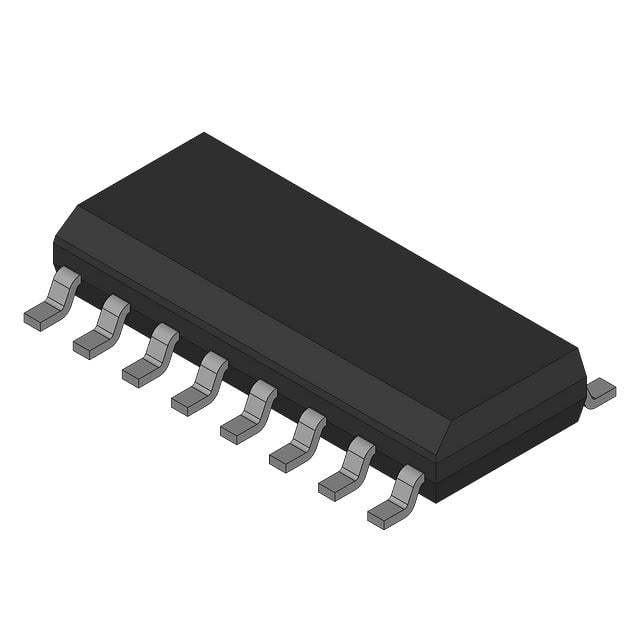
Q1: What is the Texas Instruments CD4053BE?
A1: The Texas Instruments CD4053BE is a triple 2-channel analog multiplexer/demultiplexer integrated circuit, ideal for switching analog signals in various applications.
Q2: What is the operating voltage range of the CD4053BE?
A2: The CD4053BE operates with a supply voltage range of 3V to 18V, making it suitable for a variety of low to medium voltage applications.
Q3: How many channels does the CD4053BE have?
A3: The CD4053BE has three independent channels, each with two input/output channels, which allows for versatile signal routing.
Q4: What is the logic type of the control inputs for the CD4053BE?
A4: The control inputs of the CD4053BE are CMOS (Complementary Metal-Oxide-Semiconductor) type, providing efficient operation with low power consumption.
Q5: What is the maximum current the CD4053BE can switch?
A5: The CD4053BE can switch currents up to 25mA per channel, making it suitable for driving small to moderate analog signals.
Q6: What is the package type for the CD4053BE?
A6: The CD4053BE is available in an 16-pin dual in-line package (DIP) for easy integration into various electronic systems.
Q7: What is the maximum on-resistance of the CD4053BE?
A7: The CD4053BE has a maximum on-resistance of approximately 100Ω, ensuring minimal signal loss when switching analog signals.
Q8: Can the CD4053BE be used for digital signal switching?
A8: While the CD4053BE is primarily designed for analog signals, it can also handle digital signals within the voltage range and operating conditions.
Q9: What is the typical propagation delay of the CD4053BE?
A9: The typical propagation delay of the CD4053BE is about 50ns, providing fast switching for time-sensitive applications.
Q10: Does the CD4053BE have a built-in logic-level translation feature?
A10: No, the CD4053BE does not feature built-in logic-level translation. It operates with CMOS logic levels and requires matching voltage levels for proper functionality.
Q11: What is the maximum switching speed of the CD4053BE?
A11: The maximum switching speed of the CD4053BE is typically 10 MHz, allowing it to handle relatively fast signal switching tasks.
Q12: Is the CD4053BE suitable for audio applications?
A12: Yes, the CD4053BE is suitable for audio applications, such as audio signal routing and switching, due to its low on-resistance and high switching accuracy.
Q13: How does the CD4053BE handle power consumption?
A13: The CD4053BE has low power consumption due to its CMOS technology, making it energy-efficient for battery-operated devices.
Q14: What are the control logic input voltages for the CD4053BE?
A14: The control logic input voltages for the CD4053BE are compatible with standard CMOS logic levels, meaning they require logic high (Vcc) and logic low (ground) levels for proper operation.
Q15: Can the CD4053BE be used in high-voltage applications?
A15: The CD4053BE is designed for use in low to medium voltage applications, with a maximum voltage of 18V, making it unsuitable for high-voltage systems.
Q16: What is the typical capacitance of the switches in the CD4053BE?
A16: The typical capacitance of the switches in the CD4053BE is approximately 5pF, which is low enough to avoid significant distortion in most analog signals.
Q17: Does the CD4053BE provide isolation between channels?
A17: Yes, the CD4053BE provides isolation between channels, ensuring that the signals on different channels do not interfere with each other during operation.
Q18: Can the CD4053BE handle both AC and DC signals?
A18: Yes, the CD4053BE can handle both AC and DC signals, making it versatile for various signal routing applications in different circuit designs.
Q19: Is the CD4053BE suitable for use in automotive systems?
A19: Yes, the CD4053BE can be used in automotive systems, as it operates within the voltage range typically found in automotive electronics, with high durability and low power requirements.
Q20: What are the key applications for the CD4053BE?
A20: The CD4053BE is used in a wide range of applications, including audio signal routing, data multiplexing, communication systems, and analog switching circuits.