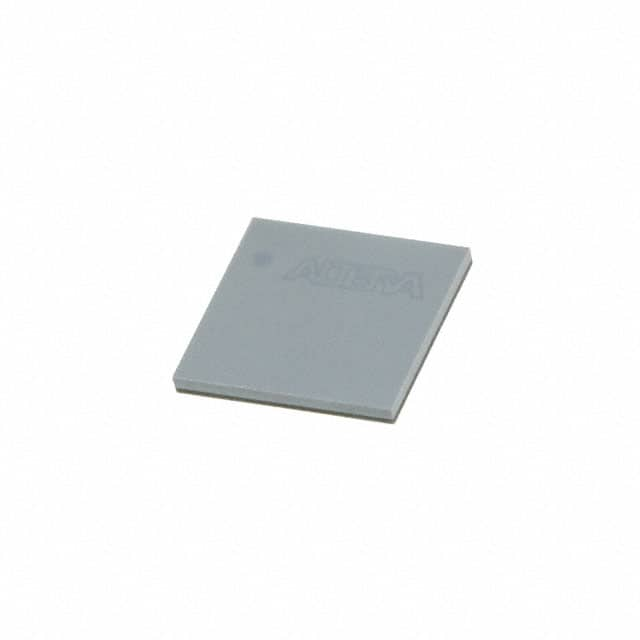
Product Overview: Intel 10M08DCF484C8G
The Intel 10M08DCF484C8G is a member of the Intel® MAX® 10 family of low-cost, non-volatile FPGAs designed for a broad range of applications requiring moderate logic density, fast configuration, integrated analog features, and low power consumption. It integrates flash memory and FPGA fabric on a single die, allowing instant-on operation and in-field reconfiguration capabilities. The 10M08DCF484C8G offers a good balance of logic capacity, embedded memory, and I/O flexibility, making it ideal for industrial, automotive, communication, and control applications.
FPGA Family and Architecture
* Family: Intel® MAX® 10
* Technology: Single-chip, flash-based FPGA
* Process Node: TSMC 55 nm embedded flash process
* Configuration: On-die flash, instant-on, non-volatile
* Device Type: Reconfigurable FPGA with integrated analog blocks
Logic and Memory Resources
* Logic Elements (LEs): 8,000 LEs
* Logic Array Blocks (LABs): ~500 LABs
* Embedded Memory: 378 Kbits of M9K RAM blocks
* Embedded Multipliers: 24 × 18-bit DSP blocks
* User Flash Memory (UFM): 8 Kbits
* Embedded Flash Memory: For configuration and user code storage
* Configuration Time: Instant-on, no external configuration device required
Package and Pin Information
* Package Type: FineLine BGA (FBGA)
* Pin Count: 484 balls
* Ball Pitch: 0.8 mm
* Package Code: F484
* Package Dimensions: Approx. 23 mm × 23 mm
* Mounting: Surface mount
* I/O Pins: Up to 248 user I/Os
* I/O Standards Supported: LVTTL, LVCMOS, SSTL, HSTL, and differential I/Os (LVDS, mini-LVDS)
Performance and Timing
* Speed Grade: –8 (medium speed performance)
* Maximum Core Frequency: Up to ~250 MHz depending on logic utilization
* I/O Performance: Supports DDR, LVDS up to 840 Mbps
* Global Clock Networks: Up to 16
* Maximum PLLs: 2
* Phase-Locked Loops (PLLs): Integrated for clock multiplication, jitter filtering, and skew compensation
Analog and Mixed-Signal Features
* Integrated ADC: Yes, 12-bit ADC
* Number of ADC Channels: Up to 18
* ADC Sampling Rate: Up to 1 MSPS
* Use Cases: System monitoring, sensor interfacing, power measurement
Power Supply and Power Management
* Core Voltage (VCC): 1.2 V
* I/O Voltage: 1.2 V, 1.5 V, 1.8 V, 2.5 V, and 3.3 V depending on bank
* Power-On Behavior: Instant-on, no need for external configuration
* Power Consumption: Low static and dynamic power; typical usage under 300 mW in moderate applications
* On-Chip Voltage Regulators: Supports power sequencing simplicity
Security and Reliability
* Configuration Security: Optional encryption and password protection
* Flash Endurance: 1,000 program/erase cycles
* Data Retention: 20 years at 85°C
* Built-In CRC: Ensures reliable configuration and data integrity
* Temperature Range: Commercial (0°C to +85°C)
Development and Toolchain
* Design Tools: Intel® Quartus® Prime Lite and Standard Editions
* Programming Interface: JTAG (IEEE 1149.1)
* In-System Programmable: Yes, supports field upgrades
* Debugging Features: SignalTap logic analyzer, in-system memory content editor, on-chip debugging
Typical Applications
* Industrial motor control and automation
* Sensor fusion and interface logic
* Communication interface bridging
* Power conversion and monitoring systems
* Embedded control for automotive subsystems
* FPGA-assisted microcontroller expansion
Advantages and Differentiators
The 10M08DCF484C8G leverages a single-chip, non-volatile FPGA architecture that simplifies board design, reduces BOM cost, and accelerates time-to-market. Its instant-on capability allows it to be used in systems where power-up timing is critical. The integration of ADCs and flash also makes it well-suited for intelligent, low-latency edge devices that must measure, compute, and control in real time.
Conclusion
Intel’s 10M08DCF484C8G delivers an efficient combination of logic resources, embedded memory, analog integration, and flash-based configurability in a compact BGA package. It is tailored for designers who require a robust, reprogrammable device with fast startup and reliable operation, particularly in industrial and embedded systems where size, cost, and performance matter.