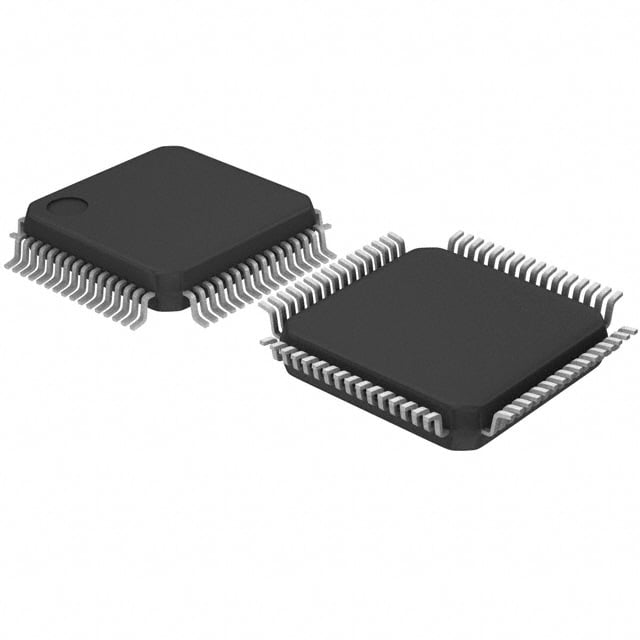
The STM32F103RET6 is a microcontroller unit (MCU) from STMicroelectronics, part of the STM32F1 series. This series is known for its broad applications in industrial control, automotive systems, medical devices, and consumer electronics. The STM32F103RET6 is a 32-bit microcontroller based on the ARM Cortex-M3 core, offering a high level of performance with low power consumption.
## Overview
The STM32F103RET6 is a mid-range MCU that features a balance of performance, power efficiency, and peripheral integration. This microcontroller is designed for applications where higher processing power, advanced connectivity, and real-time control are essential. It is built around the ARM Cortex-M3 architecture, which offers excellent performance in terms of speed, memory management, and energy efficiency.
## Key Features
1. Core Architecture:
* ARM Cortex-M3 processor.
* 32-bit RISC processor core with a high-performance pipeline.
* Features a Harvard architecture (separate data and instruction buses), which allows for high-speed execution.
* Clock speeds up to 72 MHz.
2. Memory:
* Flash Memory: 512 KB of flash memory for storing program code.
* SRAM: 64 KB of static RAM, which can be used for variables and runtime data storage.
* Memory Protection Unit (MPU): Ensures safe execution of critical code and memory access protection.
3. Low Power Consumption:
* The STM32F103RET6 is designed for low-power applications, with multiple low-power modes including Sleep, Stop, and Standby modes.
* These modes allow the MCU to be highly energy-efficient, which is ideal for battery-powered devices.
4. Peripheral Integration:
* The microcontroller integrates a variety of peripherals that enhance its functionality:
* General-purpose I/O ports: Up to 51 I/O pins.
* Timers: Multiple 16-bit and 32-bit timers for generating PWM signals, measuring pulse widths, and real-time control.
* Analog-to-Digital Converter (ADC): 12-bit ADC with up to 16 channels, useful for sensor and analog signal interfacing.
* Digital-to-Analog Converter (DAC): Provides analog output for signal generation and control.
* Communication Interfaces:
* USART (Universal Synchronous Asynchronous Receiver Transmitter) for serial communication.
* SPI (Serial Peripheral Interface) and I2C for communication with external peripherals.
* CAN (Controller Area Network) for automotive and industrial networking.
* USB 2.0 full-speed device interface.
* PWM Outputs for controlling motors, LEDs, and other devices requiring variable power control.
5. System Performance:
* The ARM Cortex-M3 core is capable of executing instructions in one cycle, achieving a maximum clock speed of 72 MHz.
* It provides excellent computational performance for real-time control applications with its nested vector interrupt controller (NVIC) for efficient interrupt handling.
6. Advanced Control Features:
* Direct Memory Access (DMA): Enables high-speed data transfers without CPU intervention, improving system performance and reducing power consumption.
* Watchdog Timer: Ensures the MCU remains operational, and if it detects software failures, it can reset the system.
* RTC (Real-Time Clock): Provides accurate timekeeping for time-sensitive applications.
* PWM/Servo Control: Configurable timers for motor control or other actuation tasks.
7. Package Type:
* The STM32F103RET6 comes in a LQFP-64 package (64 pins in a low-profile quad flat package), which is suitable for both manual and automated assembly processes.
8. Software and Development Support:
* The STM32F103RET6 is supported by the STM32Cube software development environment. It includes middleware, firmware libraries, and device configuration tools.
* It is compatible with a wide range of third-party development environments, including Keil MDK, IAR Embedded Workbench, and GCC.
## Specifications
Here are the key specifications of the STM32F103RET6:
* Core:
* ARM Cortex-M3 32-bit processor.
* Operating frequency: Up to 72 MHz.
* Harvard architecture.
* Thumb-2 instruction set for compact and efficient code execution.
* Memory:
* Flash Memory: 512 KB (program memory).
* SRAM: 64 KB (data memory).
* Clock:
* Clock Source: Internal 8 MHz RC oscillator, external crystal oscillator, or PLL (phase-locked loop).
* Maximum Clock Frequency: 72 MHz.
* I/O Pins:
* 51 I/O pins, many of which are multiplexed to support a variety of alternate functions (ADC, SPI, I2C, UART, etc.).
* Peripherals:
* Timers: Up to 3 general-purpose 16-bit timers, 1 advanced-control 16-bit timer, and 2 32-bit timers.
* ADC: 12-bit ADC with 16 channels.
* DAC: 12-bit DAC with 2 channels.
* USART: 3 channels.
* SPI: 2 channels.
* I2C: 2 channels.
* CAN: 1 channel.
* USB 2.0: Full-speed device.
* PWM Outputs: Capable of generating PWM signals for motor control or signal modulation.
* Power Supply:
* Operating voltage range: 2.0V to 3.6V.
* Low-power operation modes: Sleep, Stop, and Standby modes.
* Operating Temperature Range:
* -40°C to 85°C for industrial applications.
* Package:
* LQFP-64 (64 pins), suitable for both manual and automated assembly processes.
## Applications
The STM32F103RET6 is widely used in various industries and applications due to its balance of performance and power efficiency:
1. Industrial Automation: Its advanced control and real-time processing capabilities make it ideal for industrial control systems, including PLCs and motor control systems.
2. Consumer Electronics: The MCU is suitable for consumer electronics like smart home devices, wearables, and home appliances.
3. Automotive: Its CAN interface makes it a popular choice for automotive applications such as in-car electronics, sensors, and infotainment systems.
4. Medical Devices: The STM32F103RET6 can be used in medical monitoring devices and other low-power health-related applications.
5. Embedded Systems: It is perfect for embedded systems requiring high-performance processing, low power consumption, and various I/O capabilities.
6. Connectivity Devices: With its USB and communication peripherals, the STM32F103RET6 is used in devices requiring communication over USB, I2C, SPI, or UART.
## Conclusion
The STM32F103RET6 is a high-performance microcontroller offering a balanced combination of processing power, peripheral integration, and energy efficiency. Based on the ARM Cortex-M3 architecture, it delivers strong computational capabilities, making it an ideal choice for real-time control applications in industrial, automotive, consumer, and medical devices. Its comprehensive set of peripherals, low-power modes, and large memory make it a versatile and scalable solution for a broad range of embedded systems.