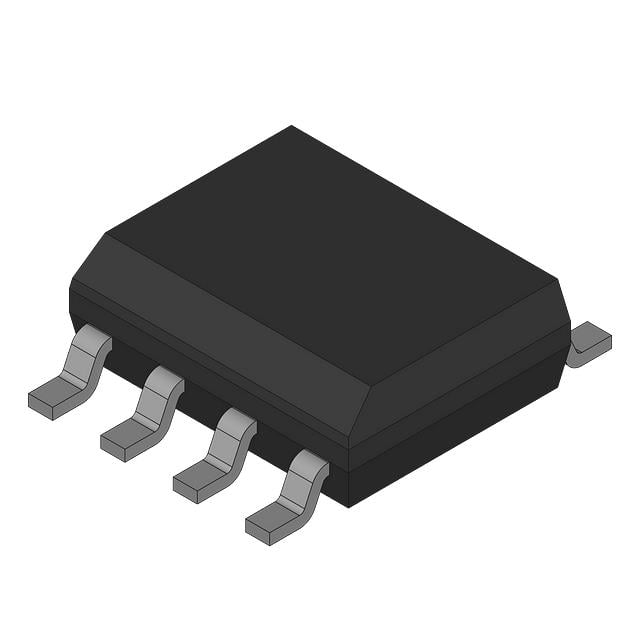
The Texas Instruments OPA2379AID is a precision, low-noise operational amplifier designed for a variety of applications, including sensor signal conditioning, data acquisition systems, and instrumentation. With its high performance, low offset voltage, and rail-to-rail output capabilities, the OPA2379AID is ideal for precision analog signal processing.
## Key Features
1. Rail-to-Rail Input and Output:
- The OPA2379AID features rail-to-rail input and output stages, allowing it to utilize the full range of the power supply. This characteristic is particularly useful in low-voltage applications.
2. Low Offset Voltage:
- The amplifier has a low input offset voltage of just 50 μV (maximum), ensuring accurate signal amplification, critical in precision applications.
3. High Open-Loop Gain:
- With a typical open-loop gain of 120 dB, the OPA2379AID provides excellent linearity and accuracy across its operating range.
4. Low Noise:
- The device exhibits low noise characteristics, with a voltage noise density of 12 nV/√Hz, making it suitable for low-level signal amplification.
5. Wide Supply Voltage Range:
- It operates over a supply voltage range of 2.7 V to 36 V, offering flexibility for various power supply configurations.
6. High Slew Rate:
- The OPA2379AID has a slew rate of 0.2 V/μs, enabling fast response times and making it suitable for dynamic signal applications.
7. Single or Dual Supply Operation:
- It can operate from a single supply (positive voltage) or dual supplies (positive and negative voltages), increasing its versatility in circuit designs.
8. Small Package Size:
- The OPA2379AID is available in a compact 8-pin MSOP (Micro Small Outline Package), facilitating integration into space-constrained applications.
## Electrical Specifications
Below are the key electrical specifications for the OPA2379AID:
- Supply Voltage Range: 2.7 V to 36 V
- Input Offset Voltage (Vos): 50 μV (maximum)
- Input Bias Current (Ib): 1 pA (typical)
- Input Voltage Range: -0.2 V to V+ +0.2 V
- Output Voltage Swing:
- Load = 10 kΩ: Vout can swing to within 10 mV of the rails
- Load = 2 kΩ: Vout can swing to within 50 mV of the rails
- Open-Loop Gain (AOL): 120 dB (typical)
- Slew Rate: 0.2 V/μs
- Unity Gain Bandwidth (GBW): 1.3 MHz
- Voltage Noise Density: 12 nV/√Hz
- Common-Mode Rejection Ratio (CMRR): 120 dB (typical)
- Power Supply Rejection Ratio (PSRR): 120 dB (typical)
- Operating Temperature Range: -40°C to +125°C
## Applications
The OPA2379AID is suitable for a wide range of applications, including:
1. Sensor Signal Conditioning:
- Ideal for amplifying signals from thermocouples, strain gauges, and other sensors in industrial and medical applications.
2. Data Acquisition Systems:
- Used in analog front-end circuits to condition and amplify signals before analog-to-digital conversion.
3. Instrumentation:
- Perfect for precision instrumentation, such as medical equipment and laboratory instruments, requiring high accuracy.
4. Audio Applications:
- Suitable for audio processing circuits where low noise and high fidelity are essential.
5. Battery-Powered Devices:
- Its low power consumption and rail-to-rail operation make it ideal for portable applications.
## Performance Characteristics
- Precision:
- With low offset voltage and drift, the OPA2379AID ensures high precision in measurements and signal processing.
- Thermal Stability:
- The operational amplifier maintains performance across a wide temperature range, making it reliable in various environmental conditions.
- Power Efficiency:
- Its low supply current (typically 150 µA) contributes to power efficiency, especially important in battery-operated devices.
## Conclusion
The Texas Instruments OPA2379AID operational amplifier is a versatile, high-performance component suitable for precision applications. Its features, including low noise, rail-to-rail output, and low offset voltage, make it an excellent choice for various analog signal processing tasks. The device's robust specifications and compact package design further enhance its appeal for engineers looking for reliable and efficient solutions in their designs. For more detailed information, engineers can refer to the datasheet available on the Texas Instruments website.